software solution · 1/30/2026 · Alfred
What Is a CRM and Why Are Businesses Switching to One Now?
What a CRM actually does, why businesses are switching now, and when central visibility becomes operationally necessary.
- Why does this problem matter in live operations?
- When does a CRM become necessary instead of optional?
- What should leaders do with these findings next?
If you ask ten business owners what a CRM is, you’ll likely get ten slightly different answers. Some think it’s a sales tool. Others think it’s just a fancy contact list. In reality, a CRM has evolved into something much bigger, and that evolution explains why so many businesses are switching to CRM systems right now.
A CRM, or Customer Relationship Management system, is software designed to store, organize, and manage customer information and interactions in one central place. That includes leads, existing customers, emails, phone calls, notes, follow-ups, and activity history. Instead of information being scattered across inboxes, spreadsheets, and individual memories, everything is visible and accessible to the business.
So what changed? Why are businesses adopting CRM systems now more than ever?
The short answer is complexity. Modern businesses deal with more leads, more communication channels, and higher customer expectations than they did even a few years ago. Email alone is no longer enough. Customers might reach out through a website form, social media, phone call, referral, or third-party platform. Without a structured system, it becomes easy to lose track of who contacted you, what they needed, and whether anyone followed up.
This is usually the moment when a business starts looking at a CRM. Something breaks. Leads are missed. Customers repeat themselves. Two people from the same company unknowingly contact the same client. The issue isn’t effort, it’s lack of visibility. A CRM solves that by creating a single source of truth for customer information.
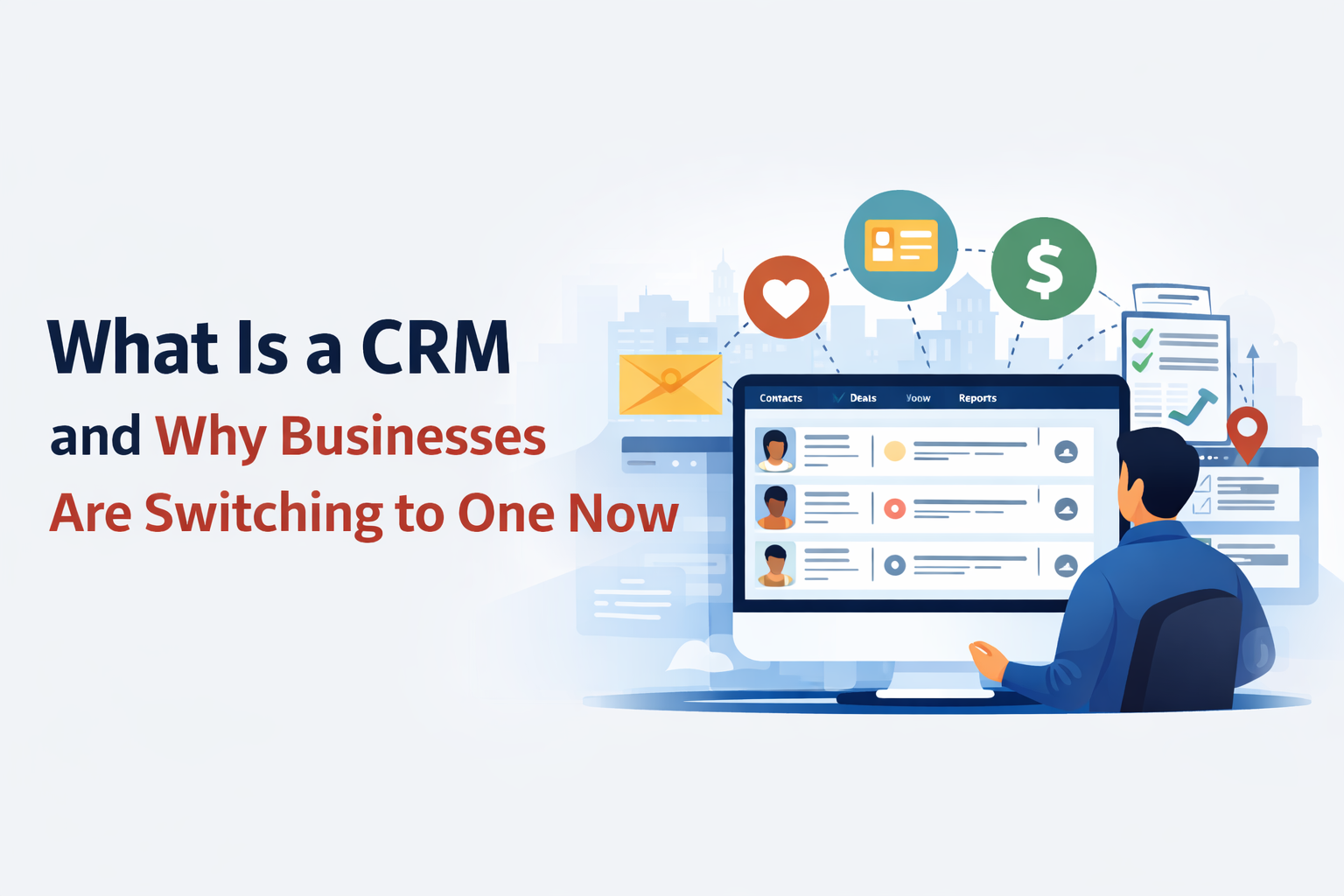
Another major reason businesses are switching to CRM systems now is speed. Customers expect fast responses. They don’t want to wait days for a reply or explain their situation multiple times. A CRM allows teams to see the full history of a customer instantly. That makes responses quicker and more consistent, even as the business grows.
Growth itself is another key factor. Many businesses operate fine without a CRM in the early stages. When there are only a handful of clients, it’s easy to keep things in your head. But growth changes everything. More customers mean more conversations, more tasks, and more opportunities for things to slip through the cracks. CRM systems provide a structure that scales with the business instead of breaking under pressure.
There’s also a shift in how CRMs are used. They are no longer limited to sales teams. Customer support uses them to track issues and resolutions. Operations teams use them to understand workflows. Management uses them to get insight into performance and bottlenecks. Even solo founders use CRMs to stay organized and intentional about follow-ups.
Businesses are also switching to CRMs now because manual tracking is inefficient. Spreadsheets require constant updating and offer no real-time context. Email threads are difficult to search and even harder to share across teams. Notes get lost. A CRM automates much of this work by logging activity automatically and organizing information in a way that is easy to retrieve.
Another important reason is decision-making. Businesses today rely more on data than instinct. A CRM shows patterns. It reveals where leads come from, how long deals take, and where customers drop off. This kind of visibility helps businesses make better decisions instead of guessing what is working.
Trust and accountability also play a role. When customer interactions live in one system, there is clarity around who is responsible for what. Follow-ups don’t depend on memory. Tasks are assigned. Progress is visible. This creates consistency for customers and accountability for teams.
It’s also worth noting that CRM systems have become more accessible. In the past, CRMs were expensive, complex, and difficult to implement. Today, many platforms are easier to use, customizable, and designed for small and mid-sized businesses. This lower barrier to entry has made CRM adoption practical for companies that previously avoided it.
Ultimately, businesses are switching to CRM systems now because the cost of not having one is higher than the cost of adopting one. Missed leads, poor customer experience, and internal confusion are expensive problems. A CRM addresses these issues by bringing organization, clarity, and structure to customer relationships.
So what is a CRM? It is a system that centralizes customer information and interactions. Why are businesses switching to one now? Because modern business demands speed, visibility, consistency, and scalability. CRM software has moved from being a “nice to have” tool to a foundational system for running a modern, organized business.
Why does this problem matter in live operations?
It matters because small structural issues become expensive when the business depends on consistent execution, shared visibility, and low-friction handoffs.
When does a CRM become necessary instead of optional?
A CRM becomes necessary when the business can no longer rely on memory, inboxes, and side spreadsheets to keep customer work moving. Once response speed, follow-up reliability, and team visibility start slipping, the absence of a shared system becomes expensive.
Microsoft's business process guidance is useful because it keeps the focus on workflow visibility instead of software branding. When customer operations become more complex, stronger internal tools and platforms often matter more than just buying another contact list.
What should leaders do with these findings next?
The useful next step is to convert the issue into an operational decision. That means identifying where the current process creates friction, who owns the fix, and what a stronger system should change in practice instead of treating the article as abstract advice.
For most teams, the gap is not awareness. It is execution. Once the problem is visible, the harder question becomes how to redesign the workflow, reduce risk, or improve visibility without adding another disconnected tool or side process.
If the issue is already affecting the business, review the relevant Prologica page on internal tools and platforms and use it as a more practical starting point for the next system decision.
Let's Talk
Talk through the next move with Pro Logica.
We help teams turn complex delivery, automation, and platform work into a clear execution plan.

Alfred leads Pro Logica AI’s production systems practice, advising teams on automation, reliability, and AI operations. He specializes in turning experimental models into monitored, resilient systems that ship on schedule and stay reliable at scale.