AI Technology · 2/1/2026 · Alfred
Why do most AI projects fail to make it into production?
Why AI projects fail to make it into production and what teams need to change to move from pilots to live systems.
- Why does this issue show up in real operations?
- What usually blocks the move from pilot to production?
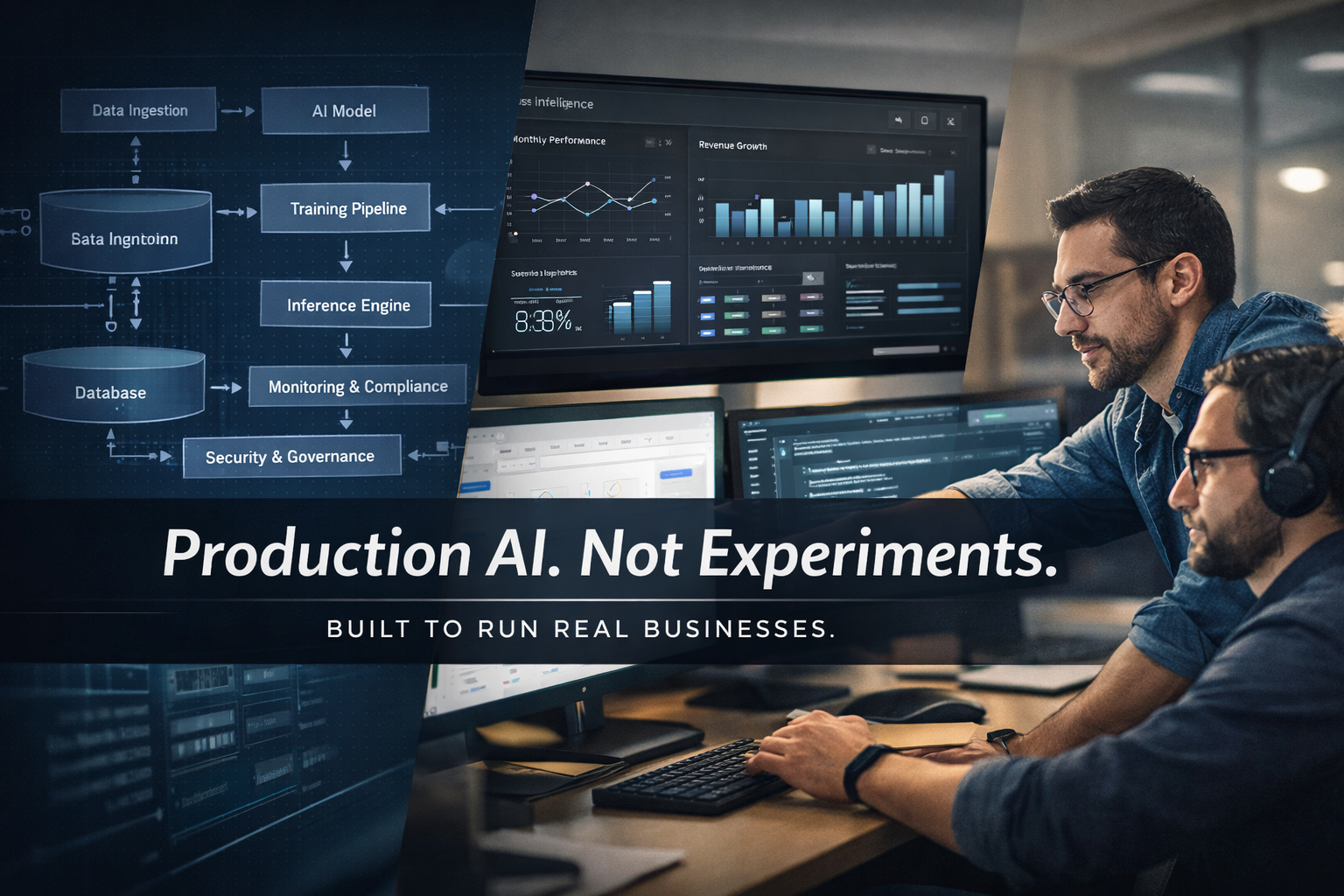
Artificial intelligence has become easier to experiment with than ever before. Models are accessible, tools are plentiful, and demos can be built in days instead of months. Yet despite all of this progress, most AI projects never make it into real production environments. They stall after a pilot, get shelved after an internal demo, or quietly fade once real-world complexity shows up.
The failure rarely comes from the AI model itself. In most cases, the model performs exactly as expected in controlled conditions. The problem is everything around it.
One of the most common reasons AI projects fail is that they are designed as experiments rather than systems. A demo is built to prove that something is possible. A production system must prove that it is dependable. These are fundamentally different goals. Experimental projects optimize for speed and novelty. Production systems optimize for reliability, clarity, and long-term use.
Many teams begin AI initiatives without defining how the system will actually live inside the business. Data sources are loosely connected. Edge cases are ignored. Assumptions are made about inputs, outputs, and behavior that do not hold once real users are involved. When the AI encounters messy data, unexpected usage, or operational constraints, the project slows down or breaks entirely.
Another major reason is integration. AI does not exist in a vacuum. In production, it must interact with databases, internal tools, authentication systems, permissions, and existing workflows. Experimental projects often skip this step. They rely on static datasets or simplified pipelines. Once the time comes to integrate with real systems, complexity increases dramatically. Suddenly, what worked in isolation becomes difficult to maintain.
Security is another critical factor that stops many AI projects in their tracks. Early demos are often built with broad access and minimal safeguards. This might be acceptable in a sandbox environment, but it is unacceptable in production. Real systems must protect sensitive data, enforce least-privilege access, and comply with internal and external regulations. Retrofitting security after the fact is expensive and risky, which is why many projects are paused or abandoned instead.
Reliability is equally important. In a demo, occasional errors are tolerated. In production, they are not. AI systems must behave predictably under load, handle failures gracefully, and recover without manual intervention. They need monitoring, logging, and alerting just like any other critical system. When these elements are missing, confidence in the system erodes quickly. Once users stop trusting an AI system, adoption drops, and the project loses momentum.
Ownership and accountability also play a role. Many AI projects start within innovation teams or research groups. These teams are excellent at exploration but are not always responsible for long-term maintenance. When an AI system transitions toward production, questions arise. Who owns it? Who supports it? Who updates it when dependencies change? Without clear answers, the system becomes fragile. Organizations hesitate to rely on tools that lack defined responsibility.
Another overlooked issue is explainability and trust. In production environments, decisions often need to be understood, justified, or audited. Experimental AI projects rarely account for this. They focus on output quality without considering how those outputs will be interpreted by users or stakeholders. When an AI system cannot explain its behavior in a meaningful way, it becomes difficult to defend and harder to scale.
There is also a tendency to overestimate what AI should automate. Many failed projects attempt to replace complex human judgment too early. Production AI works best when it supports people, reduces friction, and handles well-defined tasks. When AI is pushed into areas with high ambiguity or accountability, problems surface quickly. Successful systems are selective about where automation is applied.
Another structural issue is that many AI projects are measured by the wrong metrics. During experimentation, success might be defined by accuracy scores or demo performance. In production, success is operational. Does the system save time? Does it reduce errors? Does it fit naturally into existing processes? Projects that do not redefine success for production often fail to justify continued investment.
Perhaps the biggest reason AI projects fail to reach production is that production was never the starting point. Systems are built without considering how they will evolve over time. Dependencies change. Data grows. Business needs shift. Production systems must be designed to adapt without constant rewrites. Experimental projects rarely account for this reality.
This is where a production-first mindset changes outcomes. When AI is treated as part of core infrastructure rather than a novelty, design decisions change early. Architecture is planned. Constraints are respected. Integration is prioritized. The result is a system that may take longer to launch but is far more likely to survive.
At Pro Logica, this distinction between experimentation and production shapes how AI systems are built. The focus is not on showing what AI can do in theory, but on building systems that function inside real businesses. That means starting with architecture, defining boundaries, planning for failure, and designing for long-term maintainability.
As organizations mature in their AI adoption, expectations are shifting. Leaders are becoming less impressed by demos and more interested in systems that quietly work. They want AI that integrates cleanly, behaves predictably, and delivers value over time. This shift is exposing the gap between experimental AI and production AI.
Most AI projects fail to make it into productio,n not because AI is overhyped, but because production requires discipline. It requires engineering rigor, thoughtful design, and respect for operational realities. The future of AI will not be defined by the most impressive prototypes. It will be defined by the systems that endure, adapt, and earn trust in real-world environments.
Why does this issue show up in real operations?
It usually appears when the business process, tool choice, and day-to-day execution stop lining up cleanly. Once that happens, teams compensate manually and the friction compounds.
What usually blocks the move from pilot to production?
Most AI projects stall because the team validates a demo, not an operating model. The prototype may generate promising outputs, but the business still has unanswered questions about ownership, fallback handling, evaluation, cost, and integration with the surrounding workflow.
Production requires more than technical possibility. It requires a system that can survive imperfect inputs, changing data, and real accountability once people depend on it.
NIST's AI Risk Management Framework is useful because it frames deployment as a governance and operations problem as much as a model problem. If a team wants to move past experiments, it usually needs better AI systems and automation, not just another pilot.
Explore the next step
If you need a more structured way to address this problem, review the relevant Prologica solution page.
Let's Talk
Talk through the next move with Pro Logica.
We help teams turn complex delivery, automation, and platform work into a clear execution plan.

Alfred leads Pro Logica AI’s production systems practice, advising teams on automation, reliability, and AI operations. He specializes in turning experimental models into monitored, resilient systems that ship on schedule and stay reliable at scale.